Understanding the Causes, Injuries, and Legal Responsibility After a Rollover Crash in Arizona
Rollover crashes are among the most severe and complex vehicle accidents on Arizona roads. A vehicle can overturn in seconds, creating extreme forces that often lead to catastrophic or fatal injuries. Because rollovers involve a combination of driver behavior, roadway conditions, and potential mechanical or design defects, determining liability typically requires deeper investigation than a standard two-car collision.
How Rollover Accidents Happen
A rollover occurs when a vehicle tips onto its side or roof. While any vehicle can roll under the right conditions, SUVs, trucks, and vans are at higher risk due to their height and weight distribution.
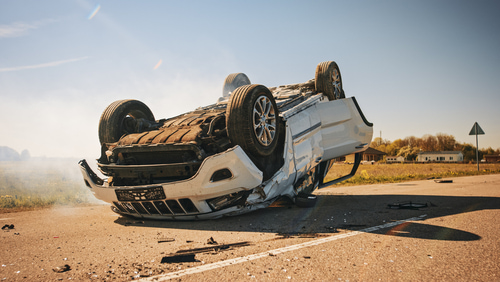
Rollovers most often stem from a combination of factors. “Tripped” rollovers occur when a tire strikes a curb, guardrail, soft shoulder, or other surface that forces the vehicle off balance. Sudden swerving or overcorrection can also cause a vehicle to lose stability — particularly at higher speeds. Tire blowouts and tread separation are another major cause; a failure at freeway speeds can instantly destabilize a vehicle. In other situations, an impact from another car, even without a direct collision, can force a driver off the road and trigger a rollover.
Arizona’s rural highways, uneven shoulders, and elevated speeds make these crashes especially common throughout the state.
The Severity of Rollover Injuries
Although rollovers make up a small portion of all crashes, they account for a disproportionate number of catastrophic injuries. The motion of a rolling vehicle exposes occupants to repeated impacts and structural failure. Traumatic brain injuries, spinal cord injuries, fractures, internal trauma, and wrongful death are all common outcomes.
Ejection is a significant risk. Faulty seat belts, malfunctioning door latches, or weak roof structures can make occupants far more vulnerable. When safety features do not perform as intended, questions of product defect often become central to the case.
Who May Be Liable for a Rollover Crash
Rollover cases typically involve multiple potential sources of liability:
Negligent drivers.
Another vehicle may cause a rollover by cutting off a driver, drifting into their lane, sideswiping them, or forcing them off the road. A physical collision is not required for liability.
Vehicle manufacturers.
Design flaws — such as a high center of gravity, weak roofs, faulty airbags, unstable suspension, or defective door latches — can increase the risks and severity of rollover injuries.
Tire and component manufacturers.
Tire failures, tread separation, and mechanical part failures can contribute to a loss of control.
Government or road maintenance entities.
Hazardous roadway conditions, missing guardrails, and unmaintained shoulders may play a role. Claims involving public agencies require strict notice deadlines.
In many cases, more than one party contributes to the crash, which means liability must be carefully apportioned.
Roof Crush, Design Defects, and Injury Severity
Roof strength failures are one of the most important elements in a rollover investigation. Under federal safety standards, a roof must withstand a force equal to three times the vehicle’s weight. Some older SUVs and trucks, and even certain newer models, do not perform well in real-world rollovers despite meeting minimum standards.
When a roof collapses more than it should, the risk of fatal head and spinal injuries increases sharply. Structural deformation, pillar failures, and improper restraint performance can all indicate a design or manufacturing defect that may shift liability onto the automaker.
What to Do After a Rollover Crash
After a rollover accident, safety comes first. Call 911 immediately and request a full medical evaluation. Even if you feel stable, internal injuries often go undetected without imaging.
If possible, and without putting yourself at risk, take photos of:
- The vehicle and any visible structural collapse
- Skid marks or debris on the road
- Soft shoulders, hazards, or roadway defects
- Weather and visibility conditions
Avoid making statements about fault at the scene. Rollover cases depend heavily on technical analysis, and early assumptions can be inaccurate. Because vehicle preservation is vital, do not allow the vehicle to be destroyed or repaired until investigators have examined it.
Compensation Available After a Rollover Accident
The physical and financial toll of a rollover can be significant. Depending on the circumstances, compensation may include:
- Past and future medical expenses
- Rehabilitation and long-term care
- Lost income and reduced earning capacity
- Pain and emotional suffering
- Permanent disability or disfigurement
- Property damage
- Wrongful death damages for surviving families
Accurately valuing a rollover injury claim often requires collaboration with medical experts, economists, and life-care planners who can project long-term needs.
Rollover Accidents in Multi-Vehicle Collisions
Many rollovers occur as part of a chain reaction. A sideswipe, unsafe lane change, or improperly secured cargo can all trigger a loss of control. In these situations, determining how each vehicle contributed is essential.
Arizona’s pure comparative negligence law allows victims to recover compensation even if they were partially at fault. Their recovery is simply reduced by their percentage of liability.
Crash reconstruction, event data recorders (“black box” data), and vehicle inspections help piece together how the rollover occurred and who bears responsibility.
How Experts Help Prove Liability
Because rollover cases are technical, expert testimony often plays a central role:
- Accident reconstructionists examine vehicle movement and crash forces.
- Mechanical engineers analyze component failures or defects.
- Biomechanical experts explain how injuries occurred.
- Human factors specialists evaluate driver reaction and visibility.
- Roadway engineers assess whether environmental conditions contributed.
This multidisciplinary approach helps uncover not only how the rollover occurred but why — and who is legally responsible.
Frequently Asked Questions
Who may be responsible if my vehicle rolled over without hitting another car?
Potentially a manufacturer, tire company, roadway entity, or another driver whose actions forced you off the road.
Can I recover compensation if I was not wearing a seat belt?
Yes. Arizona allows partial recovery, but your compensation may be reduced.
How long do I have to file a claim?
Most rollover claims must be filed within two years. Government-related claims may require much earlier notice.
What evidence matters most?
Vehicle preservation, mechanical inspection, reconstruction analysis, and medical documentation are all key.
What if a family member died in a rollover crash?
Surviving relatives may pursue a wrongful death claim for financial and emotional losses.
Contact Gallagher & Kennedy
Rollover crashes require careful analysis and a clear understanding of the factors that contribute to these dangerous events. If you or a loved one has been injured in a rollover accident, Gallagher & Kennedy’s Phoenix personal injury attorneys can help you understand the cause, examine potential liability, and explore your legal options.
Phoenix, AZ 85016